






By the JBR Battery team · Updated · 6 min read
The short answer
A car that won't start usually has a battery fault if the dash lights are dim and the starter clicks rapidly or turns slowly. It points to the alternator if the car starts with a jump start but dies again while driving. It points to the starter if the lights stay bright and you hear one click or nothing.
A four-step check you can do in the car park
You can usually tell which part has failed in a few minutes without tools, by watching the dash and listening. Work through these checks in order.
- Switch the ignition on and look at the dash. Bright, steady lights mean the battery has some charge. Dim, flickering or dead lights point to a flat battery or a loose terminal.
- Turn the key or press start and listen. Rapid clicking or a slow, laboured crank points to the battery. One solid click, or silence with bright lights, points to the starter or its wiring.
- Try a jump start. If the engine fires at once, the battery was flat, either because it is worn out or because it was not being charged.
- Watch what happens next. If the car runs and restarts later, suspect the battery alone. If the battery light stays on or the engine dies within minutes of driving, suspect the alternator.
| Symptom | Most likely cause | Next step |
|---|---|---|
| Rapid clicking, dim dash | Flat or failing battery | Jump start, then a battery test |
| Slow crank, worse after the car has stood for days | Weak battery | Battery test, likely replacement |
| One click or nothing, lights stay bright | Starter motor, solenoid or relay | Stop trying and have a technician check it |
| Starts with a jump, dies while driving | Alternator or drive belt | Stop safely, charging system test |
| Battery light on with the engine running | Charging fault | Switch off what you can and get it tested |
| Cranks at normal speed but will not fire | Fuel, immobiliser or a sensor | Check the fuel and the key, then workshop diagnosis |
| Nothing at all, no dash lights | Dead battery, or a loose or corroded terminal | Check the terminals, then test |
Signs it is the battery
The battery is the most likely cause when the engine turns slowly or the starter chatters, and the lights dim as you try. Batteries often give some warning first: a slower crank in the morning, start-stop that stops working, a clock that resets. In Dubai they can also fail with little warning, often on the first start after the car has sat in a hot basement or on beach parking while you were away.
A battery fault responds to a jump start. If the car then starts normally for a day or two and goes flat again, the battery has lost its capacity and needs replacing.
Signs it is the alternator
The alternator is the likely cause when the car starts fine but the electrics fade while you drive. The red battery symbol on the dash is really a charging warning: it lights when the alternator is not supplying the car. Other signs are headlights that dim at idle and brighten when you rev, a whining or grinding noise from the front of the engine, a smell of hot rubber from a slipping belt, and warning messages appearing one after another.
A car with a failed alternator runs on the battery alone until it is empty, often for well under an hour and for less with the AC and lights on. A jump start gets it going, then it dies again. A new battery will not fix it.
Signs it is the starter motor
The starter is the likely cause when the battery is clearly healthy but the engine will not turn. The dash stays bright, the headlights do not dim, and you hear a single heavy click, a whirring or grinding sound, or nothing at all. A jump start makes no difference. Starter faults are often intermittent at first: the car starts on the third or fourth try, or refuses only when the engine is hot.
Voltage checks with a multimeter
A healthy, fully charged battery reads about 12.6 V with the engine off, and the reading should rise to roughly 13.8 to 14.5 V with the engine running. Set the multimeter to DC volts, then put the red probe on the positive terminal and the black probe on the negative.
- Engine off, after the car has stood for a few hours: about 12.6 V is full, about 12.2 V is roughly half charged, and 12.0 V or less is flat.
- While cranking: the reading should typically stay above about 10 V. A deeper drop points to a weak battery.
- Engine running: 13.8 to 14.5 V means the alternator is charging. Under about 13 V with the lights and AC on suggests it is not. Over about 15 V suggests a faulty regulator that is overcharging the battery.
Other causes worth ruling out
Several no-start causes have nothing to do with the battery, alternator or starter, and most take a minute to check.
- Key fob battery. If the car says no key is detected, hold the fob against the start button or in the marked spot shown in the handbook.
- Immobiliser. A flashing key or padlock symbol means the car does not recognise the key. Try the spare.
- Gear selector. An automatic only starts in P or N, with the brake pedal pressed firmly on push-button cars.
- Fuel. The engine cranks normally but will not fire. Check the gauge.
- Corroded or loose terminals. A white or green crust on the battery posts, or a clamp you can twist by hand, blocks the current even from a good battery.
- Hybrids and EVs. A flat 12 V battery stops the car from switching to ready, even with a full drive battery.
What a technician checks on site
A technician confirms the fault with measurements, so you replace the part that has failed and not the one next to it. The battery is tested with an electronic tester that reports state of charge, state of health and measured cranking amps against the rating on the label. The terminals and earth strap are checked, then the voltage during cranking, then the charging voltage at idle and with the AC and lights on. If the battery keeps going flat for no clear reason, the current drain with the car locked is measured as well.
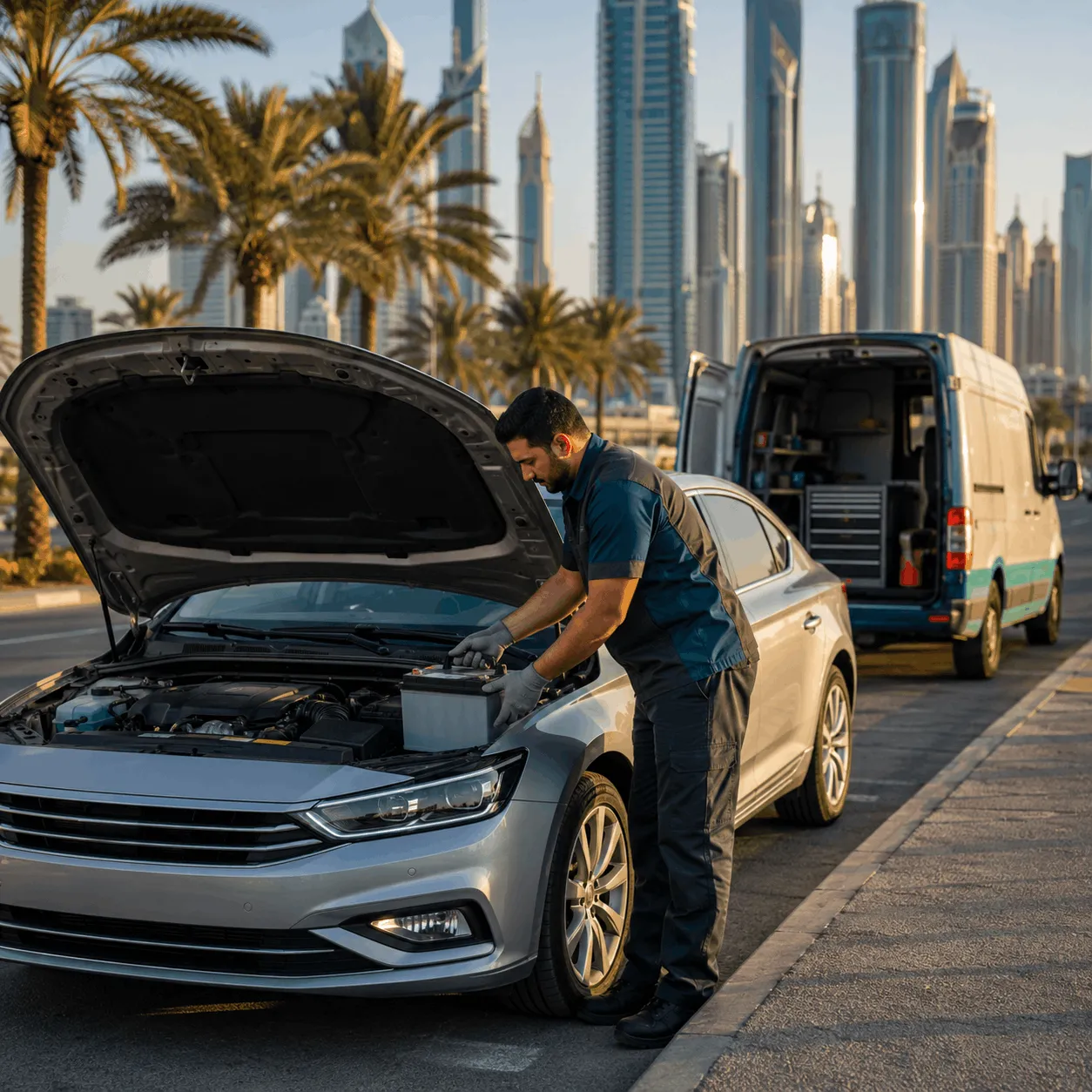
In JBR this is done where the car is parked, in a tower basement or beside The Walk, 24/7. If the battery has failed, a new one can be fitted on the spot with a warranty of up to 24 months. If the alternator or starter is at fault, the car goes to a workshop on a recovery truck.